function favicon4admin() { echo ''; } add_action( 'admin_head', 'favicon4admin' );

Qigong for Self-Healing

Scenic Sun; Qigong

Introduction

Qigong is a general term for Chinese meditations and exercises that are used to improve and maintain good health and promote longevity. Qi (pronounced chee) refers to the life force or energy within all living things. Gong refers to one’s ability or skill. Thus, Qigong means Qi ability. A person that practices Qigong develops the ability to work with and improve their own Qi, thus improving their health. With regular and daily Qigong practice, you will learn techniques to relax both your body and your mind. Qigong practice will enhance your ability to focus your mind and improve your concentration. Thus, Qigong is truly a holistic approach to natural living and training both your mind and body.

Qigong focuses on self-healing and prevention of illness. It includes movement forms (stances and exercises) and quiet forms (breathing and meditations). Qigong helps the practitioner to focus their mind and to be in the present moment, which relaxes both the mind and the body. It is difficult to relax the body if the mind is not relaxed and quiet. Qigong also helps to strengthen and increase the energy (Qi) flow in the body. As a result, Qigong provides a strong foundation that supports the body’s own ability to heal.


Qi

The “Qi” part of Qigong refers to the universal energy or life force that is present in all living organisms. According to Traditional Chinese Medicine (TCM), disease occurs in the human body when Qi flow is disturbed (excess, deficient or blocked). The disruption of the Qi flow may manifest itself as symptoms (physical or emotional). Qi flows throughout the body in energy channels.

There are twelve major Jing channels (meridians) associated with the twelve organs (not necessarily the same as the physical organs of western anatomy) of the body. There are also eight Mai channels (vessels) that store and circulate Qi. Thus, improving Qi flow in the body literally means to improve the flow of Qi in the organs. The human body relies on the proper amount and flow of energy (Qi) for maintaining good health. Consistent practice of Qigong smooths out the Qi flow by opening energy channels in the body, increasing the stored energy in the body, and by circulating the energy through the channels. Thus, Qigong allows the practitioner to “Get Qi, Feel Qi, and Use Qi”.

Qi is depleted or blocked in many ways:

  1. Too much mental or physical stress.
  2. Poor eating and drinking habits.
  3. Too little or too much sleep.
  4. Extreme emotions (joy, sadness, anger).
  5. There are many, many other ways.

It’s important to eliminate or minimize these to have a successful Qigong practice and to be happy, healthy and in harmony.

Stress and tension restrict the flow of Qi in the body. When you feel stress or tension starting, take a 5-minute break and focus on your breathing. Breathe deeply into your abdomen. It will relax you and improve the Qi flow.


Qigong State

It is important to understand the concept of Qigong State for practicing Qigong (movement forms and quiet forms). Qigong State refers to putting your mind and body into the proper state for practicing Qigong. This means letting go of all thoughts about what has happened earlier in the day or what you want to do later. It means being present in the moment, the “here and now”. It means focusing your attention on relaxing both your mind and your body. It also means making sure that your spine is properly aligned while sitting or standing. Your feet should be flat on the floor unless you are sitting in the lotus position. Also, when in a Qigong state, you should put the tip of your tongue on the roof of your mouth behind your teeth as much as possible.


Daily Practice

Daily consistent practice is an important key to improving your health through Qigong. Without practice, you cannot strengthen your body and open your energy channels. Without practice,  you cannot quiet your mind and reduce stress. You should want and love to practice. If your practice becomes a chore, then you are likely doing it incorrectly. However, if life happens and you miss a practice, don’t beat yourself up. Don’t be hard on yourself. Learn from the circumstance and see if there is something you can do to reduce the likelihood that you will need to miss a practice in the future. Just do your best. But, always smile, forgive yourself, and just let it go.

Be grateful for your practices. Be grateful for your instructors. Be grateful for all of the Qigong masters that have paved the way for us to get the knowledge and instruction. Invite your friends and family to join you for your practices. Everyone benefits and it gives you an added incentive to practice consistently and you can support each other during times when you don’t feel like practicing.


Conclusion

As we have covered, the practice of Qigong means that we train to use Qi for self-healing. The practice of Qigong relaxes both the body and the mind. Thus, Qigong is a great way to reduce the effects of stress and improve your health. Qi flows through the energy channels in the body. The practice of Qigong helps us to “Get Qi, Feel Qi, and Use Qi”. Daily practice is important for constant improvement. Having gratitude for the practice and the Qigong masters help us to keep the momentum and desire to practice.

If you would like to know more about Qigong or have any questions, don’t hesitate to contact us at http://www.innervitalityqigong.com/contact.html.

If you would like to study Qigong meditation, check out our home study kits at http://www.innervitalityqigong.com/home-study.html.

We would love to hear from you. Please leave your comments or questions about this article in the comment box below this article.


Disclosure

E-Commerce Content is independent of editorial content and we may receive compensation in connection with your purchase of products via links on this page.

Relaxation

Relax in the mountains

SadahamYathra / Pixabay

One of the most important aspects you will learn as part of Qigong is relaxation. Relaxing is important to activate the body’s healing response. Relaxing means to let go of tension and stress that is held in the body. It also means to let go of tension and stress in the mind.

Relaxing the mind allows for a deeper state of relaxation to occur in the body. So what exactly does it mean to relax your mind? The human mind is typically busy thinking tens of thousands of thoughts each day, most of which are the same thoughts day after day. On top of that, people are stressed out from work, the bills, the kids, their health issues, their families, etc. If you are experiencing similar thoughts, you may find it difficult to turn these thoughts off. Some have difficulty sleeping because they can’t shut down the thoughts and worries.

If you learn Qigong, you will learn effective techniques to quiet your busy mind. Here are a few techniques. Close your eyes and concentrate on your breathing. Focus on each inhalation and exhalation. You can even count your breath cycles. Inhale, exhale, one, inhale, exhale, two, inhale, exhale, three, and continuing for five minutes or more. Another simple technique is to repeat a mantra. That is to repeat a word or phrase over and over again. The word or phrase can be as simple as “calm” or “calm, peace, relax” or it can be a complete sentence like: “I am calm, peaceful and relaxed in all situations”. Just make sure it is something positive and empowering. Keep in mind that your mind may wander, especially in the beginning. If this happens, just bring your awareness back to your technique (count, matra, etc). It is important to practice one of these techniques consistently one or more times each day. The more you practice, the quicker you will notice the results of focusing and calming your mind.

As you learn to calm and quiet your mind, you will begin to feel less stress. This is a sign your mind is relaxing. Now it will be much easier to relax your body. Now you can use a simple progressive relaxation technique to relax your body. You can start with your head; put your attention on your face and head. Imagine all tension releasing from your head. You can lightly tense your head and face and release. Feel the tension melting away. Repeat for your neck, shoulders, arms, hands, chest, back, abdomen, pelvis, legs, feet, etc. You can spend extra time in areas that do not release. Once you finish at your feet, repeat the entire process two more times. Practice this at least once a day, following a technique to calm and quiet your mind. It is important to find a quiet place for your practice where you won’t be interrupted. Sit in a comfortable chair. You can close your eyes, but don’t fall asleep. If you tend to fall asleep, then slightly open your eyes. These simple techniques are quite effective. There are many other techniques in Qigong for training the mind and body to relax. Seek out a teacher if you want more information.

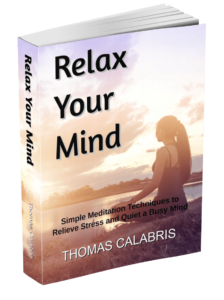
Book Review “Relax Your Mind”

Relax Your Mind Book

I have written many times about how relaxation is an essential part of our Qigong daily practice.  In Qigong, when we talk about relaxation, we mean the relaxation of both the body and the mind. It is very difficult to relax your body if your mind is not relaxed. Once we master relaxing our mind, then relaxing the body comes easier.

Since relaxation is important when it comes to healing and preventing illness, I decided to write an entire book on the subject. It is basically a practical guide to “Relax Your Mind”. In my new book entitled “Relax Your Mind”, I describe simple and effective meditation techniques for relieving stress and relaxing or quieting a busy mind.

Have you ever been lying in bed and your mind was racing and you couldn’t stop it? And it prevented you from going to sleep? It happens to most people from time to time. Perhaps this has happened to you when you were trying to meditate. We get stressed out and overwhelmed and our mind can take over if we don’t understand how it works and how to train it to our advantage.

In “Relax Your Mind”, I cover stress and how it affects both the body and the mind. You will learn what a stress response is and how to stop it. You will also learn what a relaxation response is and how to induce one to relieve stress. I discuss how the mind and the subconscious mind work. I discuss simple techniques and practices for relaxing the mind, including living in the present moment, abdominal breathing, focusing the mind, calming the mind, and retraining the mind. I also go over visualization. And finally, I put the techniques together in a very specific sequence into a ten-minute relaxation meditation.

If you experience chronic stress and you find it difficult to tame your mind, then this book is a must-read for you. These are the same techniques that I use regularly to relax my mind. These techniques came about from my previous training and my own need to reduce stress and calm my mind. I have benefited tremendously from these simple techniques and I know you can benefit from them too.

The book is available ebook format (pdf, the pdf reader is free to download from Adobe, I will provide details on how to get it) initially. Also, there are some incredible bonuses like the audio version of the book (mp3 format), a “Relax Your Mind” workbook (also in pdf format), and other great bonuses. And I think you will be pleasantly surprised at the price considering all that you will get. I’m excited to bring this step-by-step information to help you along your life journey. Click this link to learn more and get started to “Relax Your Mind”.

Haola! Haola! Haola!

Copyright © 2010-2019, Inner Vitality Systems, LLC. All Rights Reserved.