function favicon4admin() { echo ''; } add_action( 'admin_head', 'favicon4admin' );

5 Mindfulness Practices For Living In The Present Moment

Mindfulness practices: observe your thoughts, abdominal breathing, walking in the park, Tai Chi, and Qigong.

Mindfulness practices are practices that allow us to focus our attention in the present moment, which is great for relieving stress. To be in the present moment, you must let go of things from your past. Learn from things in your past and let them go. Forgive everyone that has hurt you in the past. That doesn’t mean you condone or allow yourself to be hurt by others. It just means that you accept what has happened and you are ready to move on with your life.

Also, to be in the present moment, you must let go of worry about what will happen in the future. The fear of the unknown can paralyze you and keep you from living in the present moment. Here are five powerful mindfulness practices that can have a profound effect on your life.

1. Observe Your Thoughts

Life is often so busy and hectic that we become unconscious to all of the thoughts that we think every day. As reported by the National Science Foundation, we have about 60,000 thoughts per day and about 80% of thoughts are negative. When we live most of our lives unconsciously,  then we give up the power of conscious choices. It is our conscious choices that give us the power of changing our thoughts to be more positive.

One simple mindfulness practice is to observe your thoughts without judgment. Just notice what thoughts you are having at any given moment. You may catch yourself being negative. Just accept it and don’t try to force your thoughts to be a certain way. Just observe and accept. Don’t judge yourself. Don’t criticize yourself. The conscious act of observing your thoughts without judgment has the power to change your unconscious thoughts over time.

2. Abdominal Breathing

Focusing your mind on your breathing in the present moment is a powerful mindfulness practice. It can reduce or stop a stress response and it can induce a relaxation response. Abdominal breathing is performed by slowly inhaling deeply into the abdomen and allowing your abdomen to move outward. Then as you slowly exhale, allow your abdomen to move inward. You can count your breath cycle. Inhale, exhale, 1. Inhale, exhale, 2. Repeat this practice for 5 to 10 minutes to start. If you lose your concentration and forget your count, just return your focus to your breathing and start from 1.

3. Walking in the Park

Walking in the park is not only a great way to connect with nature, but it is also a great way to be in the present moment. It can be considered a walking mindful meditation. Feel the warm breeze on your face. Notice the living animals and insects that cross your path. Here the buzz of the bees as they fly by. Connect with nature with all of your senses.

4. Tai Chi

Tai Chi has been called meditation in motion. It is a great exercise that can help your balance. It can induce a relaxation response. You become the movement rather than thinking about the movement. Feel the energy flowing through your body. You practice Tai Chi in the present moment.

5. Qigong

Qigong can have both exercise or movement and sitting meditation. Both are great mindfulness practices. Qigong is a great way to balance the mind and the body. As you practice in the present moment, you relax into the practice. You open the energy channels in the body.

It is important to understand that no matter which mindfulness practice resonates with you, the key to achieving the most benefits is a consistent daily practice. There is no substitute for practicing.

And as always, if you have any questions, you can either leave a question below or ask a question on our contact form on our contact us page. I will try to answer every question as soon as I possibly can.

If you would like more information about Qigong, contact me at http://www.InnerVitalityQigong.com/contact.html. Also, you can begin with one of our home study kits at http://www.InnerVitalityQigong.com/home-study.html.  Great things are coming to Inner Vitality Qigong and I hope that you can become a part of our journey along the path of Qigong.

CONSUMER NOTICE: We will receive payment as a result of any purchases of products via the links on this page.

Living with Change

Planet Earth - Inner Vitality QigongLife is constantly changing. So it is important to live from a place of center and balance. We often look at change as difficult or stressful. Fear of change often takes us on a detour in life that is not desired and is avoidable if we just accept it as a journey of self-discovery.

Resistance just gives more power to the change we prejudged as difficult and unwanted. Resistance is a sign that we are acting out of fear. Change requires flexibility. Rigidity is a sign of death. If we hold the things in our lives too tightly and try to force things to stay the same, we stifle the very life force that permits life. Change is the inherent nature of life itself. Without change, there would be no life.

Living with change and uncertainty requires knowing yourself, trusting yourself, living from intuition and having faith in God, the Universe, the Chi Field. When we learn how to live in the present moment and stop resisting the truth, we begin to align ourselves with our higher purpose and connect to our higher self.

Acceptance is key to living with change. Accept your circumstance without resistance and judgment. Have an open mind without attachments to the outcome. Then make an adjustment if you don’t get the outcomes that you desire.

Relaxation

Relax in the mountains

SadahamYathra / Pixabay

One of the most important aspects you will learn as part of Qigong is relaxation. Relaxing is important to activate the body’s healing response. Relaxing means to let go of tension and stress that is held in the body. It also means to let go of tension and stress in the mind.

Relaxing the mind allows for a deeper state of relaxation to occur in the body. So what exactly does it mean to relax your mind? The human mind is typically busy thinking tens of thousands of thoughts each day, most of which are the same thoughts day after day. On top of that, people are stressed out from work, the bills, the kids, their health issues, their families, etc. If you are experiencing similar thoughts, you may find it difficult to turn these thoughts off. Some have difficulty sleeping because they can’t shut down the thoughts and worries.

If you learn Qigong, you will learn effective techniques to quiet your busy mind. Here are a few techniques. Close your eyes and concentrate on your breathing. Focus on each inhalation and exhalation. You can even count your breath cycles. Inhale, exhale, one, inhale, exhale, two, inhale, exhale, three, and continuing for five minutes or more. Another simple technique is to repeat a mantra. That is to repeat a word or phrase over and over again. The word or phrase can be as simple as “calm” or “calm, peace, relax” or it can be a complete sentence like: “I am calm, peaceful and relaxed in all situations”. Just make sure it is something positive and empowering. Keep in mind that your mind may wander, especially in the beginning. If this happens, just bring your awareness back to your technique (count, matra, etc). It is important to practice one of these techniques consistently one or more times each day. The more you practice, the quicker you will notice the results of focusing and calming your mind.

As you learn to calm and quiet your mind, you will begin to feel less stress. This is a sign your mind is relaxing. Now it will be much easier to relax your body. Now you can use a simple progressive relaxation technique to relax your body. You can start with your head; put your attention on your face and head. Imagine all tension releasing from your head. You can lightly tense your head and face and release. Feel the tension melting away. Repeat for your neck, shoulders, arms, hands, chest, back, abdomen, pelvis, legs, feet, etc. You can spend extra time in areas that do not release. Once you finish at your feet, repeat the entire process two more times. Practice this at least once a day, following a technique to calm and quiet your mind. It is important to find a quiet place for your practice where you won’t be interrupted. Sit in a comfortable chair. You can close your eyes, but don’t fall asleep. If you tend to fall asleep, then slightly open your eyes. These simple techniques are quite effective. There are many other techniques in Qigong for training the mind and body to relax. Seek out a teacher if you want more information.

Book Review “Relax Your Mind”

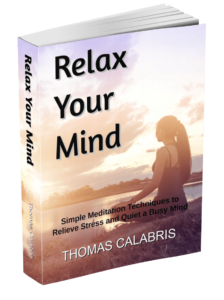
Relax Your Mind Book

I have written many times about how relaxation is an essential part of our Qigong daily practice.  In Qigong, when we talk about relaxation, we mean the relaxation of both the body and the mind. It is very difficult to relax your body if your mind is not relaxed. Once we master relaxing our mind, then relaxing the body comes easier.

Since relaxation is important when it comes to healing and preventing illness, I decided to write an entire book on the subject. It is basically a practical guide to “Relax Your Mind”. In my new book entitled “Relax Your Mind”, I describe simple and effective meditation techniques for relieving stress and relaxing or quieting a busy mind.

Have you ever been lying in bed and your mind was racing and you couldn’t stop it? And it prevented you from going to sleep? It happens to most people from time to time. Perhaps this has happened to you when you were trying to meditate. We get stressed out and overwhelmed and our mind can take over if we don’t understand how it works and how to train it to our advantage.

In “Relax Your Mind”, I cover stress and how it affects both the body and the mind. You will learn what a stress response is and how to stop it. You will also learn what a relaxation response is and how to induce one to relieve stress. I discuss how the mind and the subconscious mind work. I discuss simple techniques and practices for relaxing the mind, including living in the present moment, abdominal breathing, focusing the mind, calming the mind, and retraining the mind. I also go over visualization. And finally, I put the techniques together in a very specific sequence into a ten-minute relaxation meditation.

If you experience chronic stress and you find it difficult to tame your mind, then this book is a must-read for you. These are the same techniques that I use regularly to relax my mind. These techniques came about from my previous training and my own need to reduce stress and calm my mind. I have benefited tremendously from these simple techniques and I know you can benefit from them too.

The book is available ebook format (pdf, the pdf reader is free to download from Adobe, I will provide details on how to get it) initially. Also, there are some incredible bonuses like the audio version of the book (mp3 format), a “Relax Your Mind” workbook (also in pdf format), and other great bonuses. And I think you will be pleasantly surprised at the price considering all that you will get. I’m excited to bring this step-by-step information to help you along your life journey. Click this link to learn more and get started to “Relax Your Mind”.

Haola! Haola! Haola!

Tips To Avoid Holiday Stress

Holiday Stress

StockSnap / Pixabay

It is that time of year when a lot is expected of us to make the holidays perfect for everyone. We often sacrifice our sanity and endure a lot of stress to make it happen. Don’t let the holiday season stress you out.

Here are some tips that I hope will help to bring balance to your holidays.

1. Don’t sacrifice your health. If you exhaust yourself mentally, emotionally, and physically, then you will be of no use to anyone. Instead, put yourself first. Eat healthy, drink plenty of purified water, and get plenty of rest.

2. Remember that it is a joyful time of giving. The gifts are not the most important thing. Just being with your loved-ones is the most important thing.

3. Remember to be thankful for all of the abundance in your life. Sit quietly and take note of the people and things in your life that you are grateful for.

4. Don’t forget to breathe. Take a break and sit quietly and focus on your breathing. Breathe deeply into your abdomen. Inhale slowly and exhale slowly.

I hope you have a joyful and stress-free holiday season. Email me or add a comment and let me know what you are thankful for. I am thankful for all of the readers and students of Inner Vitality Qigong. I look forward to working with you in the coming year.

Best Chi Wishes,
Inner Vitality Qigong

Qigong Benefits

If you are wonder what the benefits are for practicing Qigong, then you have come to the right place. Did you know that there are studies that suggest that between 70-90% of doctor’s visits are stress related [1]. If that is true, then stress is an epidemic. Stress causes many issues in the body, including suppressing the immune system and digestion, hypertension, and many others. Also, U.S. Health care cost are about 17% of GDP or $2.7 trillion [2]. It’s staggering. This means that it costs about $8,508 per year per capita [2]. Of course if you have any major issues that requires hospitalization, it could be much, much more. Now here’s the good news. Qigong classes are low-cost and effective at reducing stress and improving your health, which will inevitably reduce medical costs.

Qigong Benefits InfoGraphic

So how does it work? Qigong practice relaxes the body and the mind. It opens the energy channels in the body, which improves the energy circulation to the organs and the entire body. Through practicing Qigong, you can build more energy in the body. And overtime, Qigong practice will improve your physical body condition.

For more information about Qigong Benefits, check out our article, “The Benefits of Practicing Qigong”.

References
[1] http://www.stress.org/americas-1-health-problem/
[2] http://pgpf.org/Chart-Archive/0006_health-care-oecd

Inner Medicine

In Qigong, we often talk about developing our inner medicine. This inner medicine cannot be easily seen, but you definitely know when you have developed it to be strong and active. “Dan” in Chinese means elixir or medicine. One of the major forms of Qigong that I practice is called Inner Dan Arts Qigong. It could be called “Inner Medicine Arts Qigong”. This inner medicine is the Qi that you develop in your energy centers as a result of practicing Qigong (exercises and meditations).

When your inner medicine is strong, it will protect you from stress and illness and you will feel healthy and vibrant. With consistent practice of Qigong, energy blockages are released and the Qi flows easier through the energy channels in your body. This Qi flow nourishes your entire body. The major forms of Inner Dan Arts Qigong are standing form, movement forms, breathing form, and meditation forms. Each form depends the power of your mind and visualization.

Mental concentration is important to let go of busy thoughts and distractions. This allows us to just “be” in the present moment. This mind power is necessary to relax both the mind and body. As we attain deeper relaxation with practice, the energy channels open wider and allow more Qi to flow where it’s needed in the body. We learn to connect with the energy in the universe that constantly surrounds us to build our own internal energy. Then we can guide the energy with our minds to the places in our body that are in need of healing. This is why we refer to Qigong as a self-healing technology. So I invite you to take a journey to develop your own inner medicine and take control of your health and your life. With consistent practice, you can develop your inner medicine and realize your full life potential and inner vitality.

Click here to learn more about Inner Dan Arts Qigong.

10 Tips To Reduce Stress

Reduce Stress

geralt / Pixabay

Here are ten tips to reduce stress.

1. Create a realistic plan for perceived stressful events ahead of time. Being prepared can take the edge off of stressful situations. For example, if you are doing some public speaking, either prepare an outline of your speech or write out your speech word for word. If you are traveling, print your itinerary ahead of time and leave plenty of time for rush-hour traffic.
2. Get plenty of rest. Getting enough sleep will allow you to be refreshed and focused on the situation at hand. Eight hours of sleep is optimal. If you have difficulty falling asleep, just count your breaths. This will calm your mind and you will be sleeping in no time.
3. Exercise regularly. Exercise is a great way to burn off stress-related hormones in the body. Exercise will also increase your energy and endurance, which will help you to handle physical stress more easily.
4. Participate in some mindful activity like Qigong, meditation, Yoga, Tai Chi or prayer. Mindful activities allow your mind to take a break from the mental chatter and stress. They will help you to focus your mind, which will allow you to handle stressful situations easier.
5. Eat healthy well-balanced meals daily. Never skip a meal. Skipping meals can lead to low blood sugar. It is difficult to deal with normal situations, let along stressful situations when your blood sugar is low. Low blood sugar can make you confused, moody and weak. Eating three regular healthy meals a day with some snacks in between is best.
6. Cut down or eliminate all refined foods and beverages. Stay with natural and whole foods with minimal processing. Foods that are processed typically have all of the nutrients stripped away. Then the manufactures add salt and fat to make them taste better. Don’t fall for this gimmick.
7. Engage in laughter as much as possible. Don’t take life too seriously. Take a break and do something fun now and then. Watch a comedy with family and friends. Laughter activates healing and feel-good hormones in the body. These counteract the effects of stress.
8. Spend time with loved ones. Doing things with loved ones always makes you feel connected and loved. Sharing little moments as well as big planned events. Let them know you care. This will reduce the effects of stress.
9. Breath deeply into the abdomen. Abdominal breathing relaxes and energizes the body. It also massages the internal organs. Do this routinely to relax and prevent the effects of stress from building up in the body and mind.
10. Don’t take on too many responsibilities. If you feel overwhelmed, say no. You must take care of yourself before you can take care of others. Learn to say no if you are already extended. Speaking your truth will keep you from running yourself into the ground. True loved ones and friends will respect you even more for being honest.
11. Here’s a bonus tip. In the words of Dr. Wayne Dyer, “Have a mind that is open to everything and attached nowhere.” Let go of all expectations and judgments and just live in the moment. If your mind doesn’t expect it to be stressful, then it won’t be. Normal stress is typically a product of an overactive imagination based on fear. Let go and let God, as the saying goes.

Copyright © 2010-2019, Inner Vitality Systems, LLC. All Rights Reserved.